
From Discontent to Demonstrations: Protests Unfold in Gilgit Baltistan
The departure of the British from the Indian subcontinent left behind a myriad of unresolved issues. One such unresolved matter was the fate of the princely states, which were left without a clear solution regarding their provincial status. In Gilgit Baltistan, the princely states, along with the Gilgit agency, aligned themselves with Pakistan after engaging in wars with the Dogras, led by residents. However, the governance of this region has been centralized, with significant control vested in the bureaucracy, and the assembly established in 2009 remains largely devoid of any substantive authority.
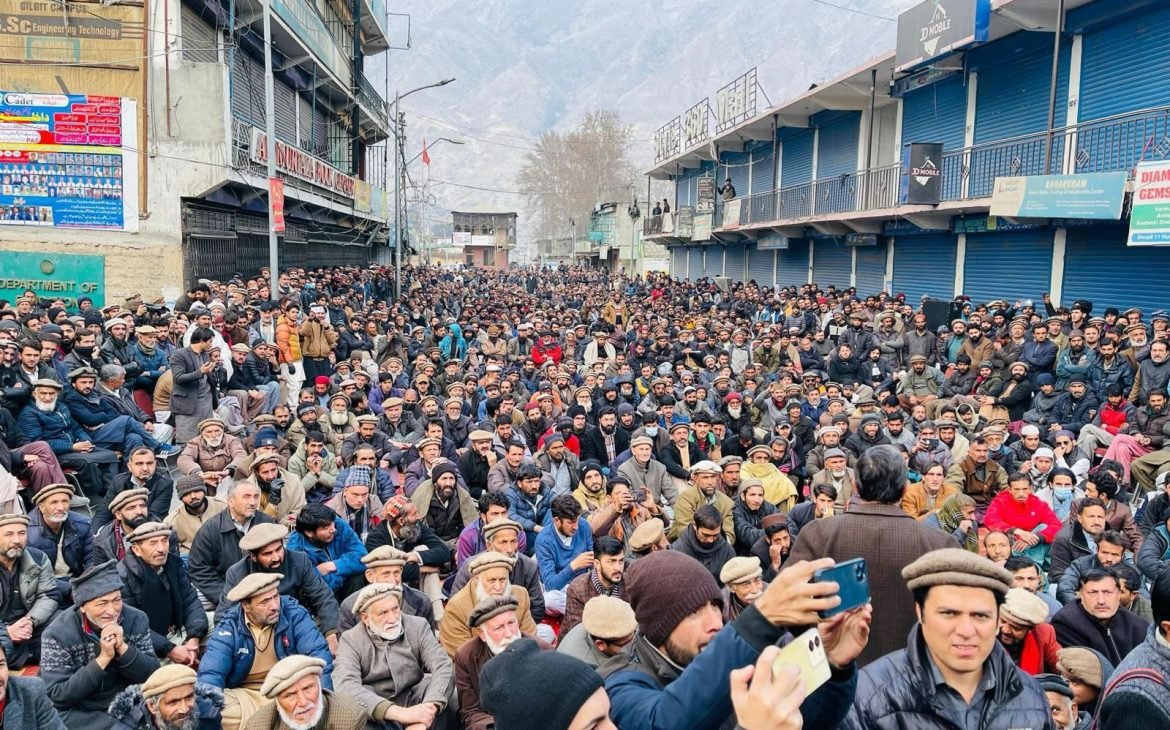
Over time, the people of Gilgit Baltistan have voiced their concerns and protested against the lack of rights and representation. The ongoing protests in the region are now regarded as one of the most significant demonstrations in its history. These protests were triggered when the central government withdrew the wheat subsidy, leading to a drastic increase in wheat prices. Compounded by the absence of a provincial setup, the region relies entirely on the central government for its budget.
Initially centered on the withdrawal of the wheat subsidy, the protests in Gilgit Baltistan have evolved to encompass a broader agenda of 15 points. The demonstrators demand that their grievances be addressed by the central government. This article delves into the historical context of the protests, examines the 15-point agenda, and explores potential pathways for resolution and progress.
The background of the protests in Gilgit Baltistan (GB) is marked by a convergence of various factors that have intensified, prompting people to rise for their rights. The cancellation of the wheat subsidy through bureaucratic channels added fuel to the existing discontent and distrust among the people regarding their status within the country.
The people of GB have long been advocating for provincial status since their integration into the Federation of Pakistan. However, the unresolved issue of Kashmir has been consistently cited as the primary reason for withholding provincial status from GB. Over the years, a multitude of factors has contributed to the deepening mistrust of the people in GB toward the central government.
The region faces a plethora of challenges, including a lack of essential facilities such as well-equipped hospitals, educational institutions, proper roads, connectivity to remote areas, basic infrastructure, representation in the central government, and access to the national power grid, a functional assembly, and an independent budget. This deficiency forces the region to heavily rely on subsidies.
The provision of subsidies to GB initially began in the 1970’s when Zulfikar Ali Bhutto visited the region, nullifying the princely rule. He announced subsidies on 17 products, which were gradually withdrawn by the central government. The recent withdrawal of the wheat subsidy, following a historical pattern, triggered protests across various districts of GB.
The Awami Action Committee (ACC) responded by calling for a complete lockdown on January 27th and 28th, 2024. In Gilgit city, a significant number of people gathered to protest, demanding their rights. The ACC’s charter outlined key agendas, urging the federal government to take action.
One of the central points in the Awami Action Committee’s (AAC) agenda was to grant Gilgit Baltistan a setup similar to that of Kashmir, ensuring autonomy over its resources, an independent budget, the appointment of its own President and Prime Minister, and a share in the NFC awards. Another key aspect of the agenda revolves around the concept of “Khalisa Sarkar,” where people seek autonomy and control over their ancestral land.
A critical question arises: how can the state lay claim to land that is not constitutionally recognized as a part of Pakistan? This raises fundamental concerns about the legitimacy of asserting authority over regions that may not be officially incorporated into the constitutional framework.
Even though the government has reversed its decision and reinstated the wheat subsidy promptly, the protests persist, with the Awami Action Committee (ACC) dismissing the notification as ineffective. To move towards lasting peace in the region, the government needs to take immediate and constructive steps. Proposed solutions include reinstating subsidies on all major items initially provided to the people and considering the longstanding demand for special status in the region.
Given the current political climate, implementing these solutions may be challenging under a caretaker setup. However, with upcoming general elections scheduled for February, major political parties could seize this opportunity to include these solutions in their manifestos, offering a potential way forward for the people of Gilgit Baltistan.
For those protesting in Gilgit, it is advisable to form a committee and present their demands as a resolution to the leading political parties in power and all other stakeholders. Meaningful talks should be initiated with all involved parties to ensure the protests address broader issues beyond the wheat subsidy. The demonstrated unity and solidarity among the people from various districts are praiseworthy and could mark the beginning of a movement in Gilgit Baltistan, seeking autonomy over its resources.
The ongoing struggle of the people of Gilgit Baltistan (GB) for their long-awaited rights is an arduous journey, demanding sacrifices, as is typical for any movement. The activism of the youth has the potential to reshape the political landscape of GB in the days ahead. The pivotal question remains in the hands of the people of GB – how they leverage this protest as an opportunity to engage in meaningful dialogue with stakeholders and turn the tides in their favor.
The effectiveness of the campaign hinges on the future actions taken by the Awami Action Committee (ACC) and other key stakeholders. This movement represents a critical juncture for GB, offering the chance to address longstanding grievances and claim its rightful share. I sincerely hope that this collective effort contributes to Gilgit Baltistan achieving the recognition and rights it has long deserved. In the face of challenges, may this movement be a catalyst for positive change and progress in the region.
Leave a Reply